

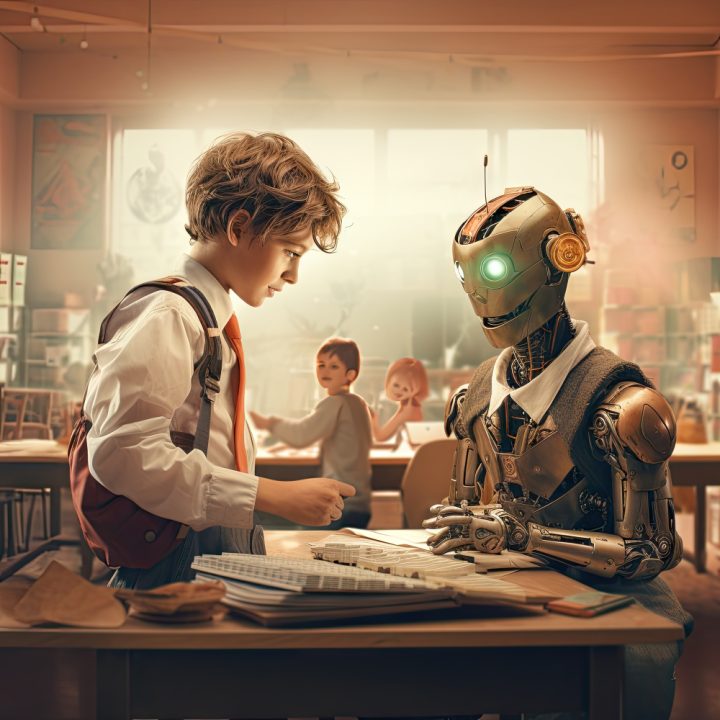
Artificial Intelligence, or AI in short, is transforming many things in our lives. One of the biggest changes is within the education field. AI can be used to assist students with learning, as well as to make the teacher’s workload easier. It is being implemented in schools, colleges, and other places of learning.
In this article, we will discuss the impact AI has had on the education industry and what it holds for students, teachers, and parents in the near future.
1. Tailored Instruction For Every Individual
Every individual has their unique item of learning. Some students may be faster learners while some take their time. In a face-to-face class, it’s almost impossible for instructors to provide individual attention to every student.
AI does assist with personalized learning. This is when the computer assesses how a student is performing and crafts lessons and activities for them that fit their performance level. For instance, if a student struggles with math, the AI can give them more practice problems that explain the concepts in a less structured manner.
Companies such as Khan Academy, DreamBox, and Knewton have adopted AI for this. These platforms increase student confidence as they are able to understand the subjects because the classes are targeted towards them.
2. AI-Powered Tutors
Think about having a personal tutor who will always be ready to assist you regardless of the time. AI tutors make this possible.
For instance, Google’s Socratic and Duolingo have AI that can respond to questions, explain concepts, and aid learners in doing some practice. Such AI tutors are beneficial to students who have limited access to help from parents or teachers.
AI tutors do not take the place of real teachers, but they serve as a great supplemental resource when extra help is needed.
3. Reduced Administrative Tasks Allocated to Teachers

Aside from preparing lessons, teachers have to deal with administrative tasks such as grading papers, marking attendance, and even setting class schedules. These tasks take time away from teaching.
Reliance on AI can help address some of these tasks, such as automating them. For example, Gradescope offers time-saving solutions for teachers by checking students‘ responses and even reading cursive. This can help save instructors hours of work.
With AI managing simple, repetitive tasks, teachers can allocate more time to planning lessons, assisting students, and focusing on the core of their profession: teaching.
4. Assisting Students with Learning Difficulties at an Early Stage

Quietly, some students are struggling behind the scenes where no one can see them. They may not reach out for help, and help might come their way too late. AI has the potency to mark a student who is falling back.
AI algorithms can analyze grades, attendance records, and student participation to identify engagement issues and lower performance, which marks students in danger. Such programs can notify instructors to allow them to intervene before students experience too much academic strain.
Such intercession can help avoid giving up on school or students.
5. Helping Students with Disabilities and Language Difficulties

A student with disabilities or someone who speaks another language is bound to find technology integration helpful.
Also, students with learning disabilities benefit from tools such as text-to-speech, which reads written material aloud.
Students who require verbal communication to type can utilize speech-to-text options.
Translation tools enable students who follow along in other languages to comprehend the material the teacher is presenting.
All of these technological advancements enable more students to actively participate in lessons at all levels, feeling accepted and empowered.
Microsoft’s Immersive Reader and Google’s Live Transcribe are excellent illustrations of how modern technology has improved the learning experience across all ages.
6. Smart Technology and Virtual Classrooms

Schools adopted the online learning model as one of the ways to mitigate the spread of the COVID-19 Virus, and during these trying times, AI was employed to improve the user experience within these virtual classrooms.
Some of the things AI can do include:
- Assisting the instructor in monitoring active versus passive students and their engagement levels.
- Administering minor quizzes throughout the lesson.
- Providing immediate answers to questions posed by students through chatbots.
Some institutions have even integrated Artificial Intelligence (AI) with Virtual Reality (VR) and Augmented Reality (AR) technology. This enables the learner to ‘travel’ to specific locations such as Rome during its glory days or look at various parts of the human body in 3D, all from a computer or VR headset.
Fun and interactive learning experiences are being created by education technology companies (EdTech) with the help of AI.
7. Concerns and Challenges of AI in Education
Despite all the benefits AI offers, there are always some things we have to take caution with.

a. Data Privacy Issues
In the education sector, AI tools harvest an enormous amount of data concerning students, which include what they learn, how they learn it, and what time they use the tools. This data requires confidentiality and protection.
For schools, enabling compliance around data provision within the system becomes paramount. The data must be protected against breach scenarios and cyber-attackers.
b. Fairness and Bias
It is common for AI systems to have predefined biases embedded within them. An example of this is the use of an algorithm that favors a selective cohort due to biased input data. Data from a specific place will more often than not maintain a certain style of writing, which can lead educators to exercise bias when grading.
Much as AI has proved beneficial, its value cannot overwrite the essence of a teacher. Care and emotional investment play significant roles in educating students. Be it relationships or motivation, teachers offer students the best forms of encouragement.
AI will take time to perfect, as a result, it is unlikely to aid teachers directly. Instead, pointing out areas in which a teacher has to put more effort and exhibiting those tasks to the AI will yield more accurate results.
8. What the Future Looks Like
There is no doubt that AI has proven its worth in the field of education. Additional options are still viable for enhancement, for instance:
Learning for Life—targeted toward adults wishing to cultivate new formulized skills or hobbies.
Short Lessons—high-level overviews that transform traditional lesson plans into modules or milestones with achievable learning objectives.
While instructors are poised to aid supervision and mentoring increasingly, students will experience unshackled freedom toward working alongside AI. The technology will redefine lesson delivery, structuring, and grading with great accuracy while assisting educators with needs beyond paperwork.
The schools that leverage AI efficiently and have recently integrated it will ease student learning and enhance their academic performance.
Conclusion
AI is transforming education with its many functionalities. It allows learners to progress in their learning at their own pace and provides assistance at any hour, and lesson planning has become less stressful for educators. It also aids in identifying students who require additional attention or those who have learning disabilities or language needs.
However, we must exercise caution as well. There is a need to protect the privacy of students’ data, ensure that there is equitable treatment within AI algorithms, and appreciate that human teachers continue to be fundamental within the classroom.
Overall, the use of AI is here to stay; thus, the focus should not be about the shift introducing AI technology or to human instruction, but rather how best to integrate them to optimize students’ learning and development.