


Schools have fully integrated personal AI into their systems, with its capabilities extending well beyond automated chatbots. In the past few years alone, AI technology has advanced remarkably and now single-handedly paves the path for self-governing learning. Switching the focus from educators teaching students to students learning on their own marks a significant leap in a students’ growth journey. Now every student can simultaneously learn at their preferred pace, enabling teachers to focus their efforts where needed most. Their administrative responsibilities AI is taking off their hands include lesson tailoring, scheduling, attendance tracking, and hundreds of other time-consuming tasks.
AI in Education: Increasing Teaching and Learning Benefits
From third graders to undergraduates AI tools are being accepted all around the world. With the current technology grade levels seem to not matter. Recently, every level of education AI tools have been integrated on, from lesson conception to assessment, including remote learning modules. Here are some changes educators made towards implementation:
1: Automatic Lesson Customization
According to research conducted with educators around the world, they all agree the best use of AI Tools in the classroom is for lesson personalization. Using tailor made lesson plans and specialised tutoring systems students can learn at their provided pace. Adaptive learning is another popular technique where platforms adjust based on results from proficiency evaluations.
Let’s look at an example:
A math educator may make use of the AI tools DreamBox or ALEKS to create custom assignments for different learners. Each student’s grade for the subject is an average of all the assignments they complete, leveling up their grade in the process.
Duolingo is another example. Users may learn a new language but the app controls the speed of the training and the content of the lessons and adapts them based on progress.
Every student is accommodated and no one is left behind. More advanced learners can also progress without having to wait for others.
2. Relieving educators of repetitive, time-consuming tasks.
Teachers often deal with a myriad of paperwork ranging from grading to preparing lesson plans. This is when AI tools can step in and help lighten their load. Gradescope and Google Classroom are some examples of AI powered tools that can: What is English essay evaluation AI?

- An AI powered evaluation system that grades quizzes, essays and multiple-choice exams will provide feedback in real time.
- AI powered tools such as Canva’s presentation AI and Chat GPT enhance the productivity of teachers by enabling them to rapidly develop new teaching material.
- With all these worries pre-processed for teachers, they can now spend their time focusing on the students and instruction.
3. Increasing engagement in classrooms
- AI technology increases motivation and participation in students by using creativity and interactivity within lessons.
- Learning and teaching are made even more advanced through the use of AI powered teaching gamification programs such as Kahoot! or Quizizz which turn learning into a fun competitive trivia.
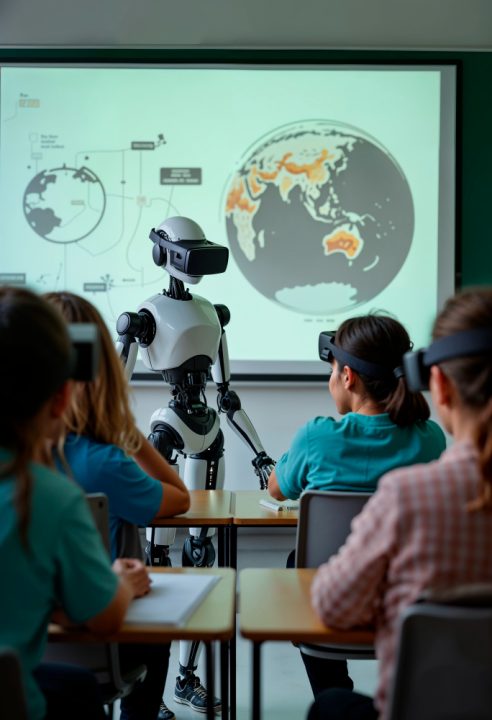
- Platforms like ClassVR allow teachers to take students on virtual field trips which enhances lessons through immersion.
- Virtual Reality helps students especially those who do not respond well to conventional muses, remain motivated and curious.
4. A Teacher’s Assistance
AI enhances the communication flow of information between a teacher and a student. Teaching platforms, such as Edmodo, utilize machine learning to assess students’ work and provide instant feedback. This enables teachers to identify problem areas more efficiently. For learners, receiving constant feedback boosts their confidence and comprehension of the subject.

5. Assisting Learners Experiencing Special Difficulties
AI tools strengthen teachers and help deliver special and inclusive education to learners with special needs:
- Speech to text programs such as Otter.ai assist learners with hearing impairment or learners with moderate forms of dyslexia.
- Kurzweil Education uses AI to help struggling readers understand coursework far more easily with lower reading aids.
- Applications like MindMup aid students with ADHD in organizing their ideas through digital mind maps.
- With these aids, teachers can provide an accommodating environment tailored to individual needs.
The Benefits of Using AI in Teaching
AI not only enhances the efficiency of teaching activities, but also improves the quality of instruction. Here are some of the mentions benefits:
- Better Results: Teaching is made easier as a result of the use of AI powered applications. AI greatly enhances learning and student outcomes. Teachers do not spend much time on repetitive work such as grading and attending to mark registers.
- Better Learning Outcomes: The AI-driven personalized learning system guarantees improved comprehension and retention of knowledge.
- Access to Valuable Insights: AI technologies provide analytics concerning the performance of a classroom, making it easier for educators to recognize patterns, gaps, and areas that need attention.
- Enhanced Collaboration: AI is now available on the cloud making communication and collaboration between educators and students easier whether they are in the same room or not.
While discussing the positive impacts of Artificial Intelligence on Education, one should not ignore the challenges and disadvantages AI would create in classrooms.
1. High Costs
Purchasing licenses for different programs and tools comes at a steep price. This leaves underfunded schools unable to afford many of AI’S offerings. Even when programs are subsidized purchasing the relevant equipment (computers, VR kits, etc.) places extra financial strain.
2. Lack of Training
Professional development in the use of AI tools is seldom available. The fast-rate technological adoption leaves little time for training development which means educators are not adequately prepared to integrate AI into classroom learning.
3. Concerns about Data Privacy
The primary AI model discussed depends on the collection of data like videos, photos, and personal information of students and even teachers. This brings out ethical issues regarding privacy, safety, and confidentiality. Parents and educators particularly become concerned about the storage practices and the intentions behind the use of such data by organizations.
4. Technology Dependence
There is also a noteworthy risk of dependence on AI tools. Such over reliance may slow student interaction. Human beings, especially teachers, provide a form of nurturing care that assures emotional well-being which is absent in AI.
5. Algorithm Discrimination
No algorithm is fully free from bias. Insidious discrimination from the way programmers design the algorithms can lead to the incorporation and reinforcement of preconceived ideas about different learners.
Finding the Most Effective Solution
To optimize the use of AI in education while addressing potential shortcomings, schools and educators should direct their attention toward:
- Providing Subsidized AI Technology to Schools: Organizations can offer funding or subsidized aids to low-income institutions to assist in the effective integration of AI technology.
- Expanded Instructional Materials: Workshops and other professional advancement activities can prepare educators to effectively manage and utilize the AI tools.
- Focus on Students’ Needs: Encourage caring teacher-student relationships where there is an appropriate balance of digital and human interaction.
The Future of AI in Education
AI is presently revolutionizing parts of education, and the future looks bright. Teachers alongside institutions are now integrating cutting-edge AI tools. AI has unlocking the potential for educators to customise instructions to tutoring level and make learning more effcient. However, the cumbersome areas such as fairness and equity require a collective strategy to solve for low-grade AI to become beneficial. Implementing AI has the potential to overcome many current challenges with integrating accessibility.
The imminent future, alongside embellishing today’s advances of technology such the internet, will in turn set the bar higher. AI tutors can only enhance today’s learning experiences. However, they can’t take over the teacher’s role. Teachers will remain the fundamental pieces of frameworks in every tech driven society. In addition, newer technologies will inspire creativity and trust, so students and learners will become more and more empowered by the teachers. Students can grow up feeling encouraged, motivating the new generation actively supplementing positively redefining the world for the better.